


The most important decision to make for a patient considering breast augmentation is who is performing the surgery. Choosing a board-certified plastic surgeon with vast experience in breast augmentation surgery is a must. Dr. Yates is a board-certified Utah plastic surgeon who specializes in breast augmentation and has performed well over 2,500 of these surgeries.
In choosing a breast implant, the important decisions that must be made to help achieve the desired breast augmentation result are 1) implant size and dimension, 2) implant type (saline vs. silicone), 3) below or above muscle, 4) breast implant shape, 5) incision choice. Of these, the MOST important considerations are breast shape and size. How large do you want your breasts to look? Do you care if your breast size matches your frame or is bigger better? Are you interested in a more natural breast augmentation result or more of an augmented, very round, breast?
Other than choosing the best plastic surgeon for you, breast implant size is probably the second most important and challenging decision to make. Dr. Yates will help you pick the ideal breast implant size based on breast dimensions, skin envelope, and desired shape. You will then “try on” external implants of various sizes based on ideal fill and desired goals to help you and Dr. Yates fine-tune your goals. Looking at a simulated result with 3D breast imaging helps with this communication. Looking at photos on this site, RealSelf and others can help get an idea of implant size. We want you thinking in terms of cc’s rather than cup size. Cup size is quite variable depending on the width of the chest and bra manufacturer. As a general guide, for a narrow patient, an increase in one cup size is in the 125-150 cc range where an average patient is in the 125-175 cc range and a wide patient in the 200-250 cc range. Our opinion is that you should choose implant size based on the dimension and the look that you want, worrying less about the bra size.
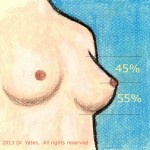
“What will I look like after breast augmentation.”
Dr. Yates is one of the few Utah plastic surgeons with Vectra 3D breast augmentation imaging. A 3D image is taken, and a simulated image is created. This is excellent in determining degrees of asymmetry. A patient can “see” their shape and size before surgery.
Generally, if women are unhappy with their choice of breast implant size, they wish they had gone larger. However, there are disadvantages to going too large, with higher complication rates associated with larger implants. Larger implants certainly look and feel less natural as well. This is what makes this decision so difficult.
1) Round silicone breast implant
Advantages: Silicone breast implants are more natural feeling than saline implants. Silicone implants have a lower risk of breast implant visibility and rippling. Silicone implants can have a more natural shape, particularly for very small-breasted women. Ruptures are less common. Generally, silicone breast implants have higher patient satisfaction. Most of our Utah patients are choosing silicone over saline.
Disadvantages: Silicone breast implants are more expensive than saline. Because they come pre-filled, the incision and scar are longer. There is less adjustability with silicone implants if the breast size is different. Although silicone ruptures are less common, if a silicone breast implant fails, this can result in a “silent” rupture that could lead to breast hardening or deformity.
2) Teardrop shaped breast implant (anatomical or gummy bear)
These implants provide a more natural shape even with larger sizes and have lower rates of capsular contracture than traditional silicone implants. The scar is a little larger with these implants (2″); they are a bit more expensive and firmer. There are a few unique risks with these implants and in many offices, including ours, they are being used less frequently than a few years ago.
The specific risks include rotation, fluid accumulation, and BIA-ALCL.
3) Saline breast implant
Advantages: Saline breast implants are less expensive. Their scar can be smaller, and there is more adjustability of breast size with saline implants. If there is a failure, a saline implant deflates, and it is relatively simple to have a new implant replaced.
Disadvantages: Saline breast implants are a little less natural feeling and more prone to rippling. For smaller breasted women, the shape with saline implants can look rounder and generally more “augmented.” There is a new saline implant, the ideal implant that has many of the advantages of silicone in regards to feel and rippling but is saline-filled.
For nearly all-round breast implants, Dr. Yates believes that implant placement below the muscle gives a more natural result. In reality, this is a “dual plane” approach with a portion of the implant covered by implant and a portion that is not.
Long term benefits of breast implants beneath the muscle include; improved shape, less implant edge visibility, less theoretical interference with mammography and decreased risk of capsular contracture.
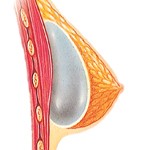
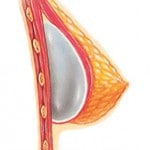
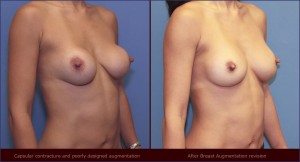
This patient presented to Dr. Yates with a subglandular breast implant and capsular contracture. Revision required breast implant and capsule removal and implant pocket change to below the muscle for improved shape and decreased risk of recurrence of capsular contracture.
The biggest problem with submuscular placement is that the implants can move significantly with pectoral muscle motion. Depending on the shape and strength of the muscles, this can be embarrassing pushing the implants to the sides. To minimize these issues, a subglandular position can be chosen. The ideal candidate for a subglandular implant has ample coverage to prevent implant rippling.
The dual-plane technique of breast augmentation is a technique where the implant is placed in a partial submuscular pocket and partial subglandular pocket to maximize some of the advantages of placement below and above the muscle. In simple terms, the lower pectoral muscle is released from both the chest wall below and the breast tissue above. The muscle lifts above the lower part of the implant, which helps to elevate a slightly droopy breast. The upper muscle coverage helps reduce risks of contracture and improve implant coverage.
Dr. Yates uses a simple dual-plane technique for most breast augmentation surgeries and a more aggressive version in specific cases to help release a tight lower pole or improve mild droop. A dual plane technique is not a substitute for a lift for a patient with significant droop.
For years supporting the breast tissue over the implants in a lifted position with sutures has been theorized and tried. In practice, there have been no studies showing success but many studies showing the failure of these approaches. In general, an implant alone does an “internal lift” to the breast. This effect can be enhanced with modern dual-plane approaches. However, if a patient needs a lift beyond what an implant and dual-plane approaches can improve, internally supporting with sutures is never enough, and a formal breast lift is necessary.
A newer concept is adding supporting tissue around an implant. This is one of the so-called “internal bra” procedures. Galaflex is the current favorite among many plastic surgeons. I am a fan of it in revision surgery when we need to add support to the capsule. Whether there is any benefit in primary augmentation cases is unknown. Certainly, there are additional costs and risks but there is no data that there are improved long term results. Dr. Yates, forever the skeptic is in the analysis phase of this.
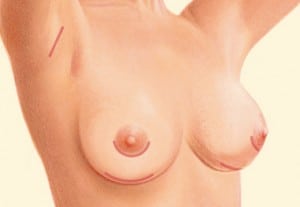
- ) Transumbilical breast augmentation (TUBA) – The incision is placed around the belly button. The breast implant pocket is developed through this incision through a small tunnel in the abdomen. Dr. Yates feels strongly that this is a very inaccurate method for breast augmentation. Only saline implants can be used. Any revisions (which are unfortunately all too common with this incision) need to be done with a large incision on the breast. This incision is marketed as “scarless breast augmentation.” It is an excellent marketing tool… who wouldn’t want breast augmentation without scars? The problem is that the risk of implant rupture is higher, and the risk of implant malposition is extremely high. Most plastic surgeons would never consider this incision, and it is a passing fad.
- ) Axillary (armpit) incision – The advantage is there is no scar on the breast. Dr. Yates does not generally prefer this incision as there is no way to feel (with fingertips) inside the implant pockets simultaneously to be sure they are exactly the same. This makes this incision choice less accurate with a higher revision rate. Any revision requires an additional larger scar on the breast.
- ) Periareolar (around the nipple) – If this scar heals well it can be nearly invisible – hidden in the color contrast between the skin and areola. Concerns with this incision include a slightly increased risk of loss of nipple sensation, possible interference with breastfeeding, and a risk of infection and capsular contracture from bacteria in the milk ducts. This is losing popularity, and many plastic surgeons no longer offer this incision due to these risks.
- ) Inframmamary (below the breast within the crease) – The most popular choice for breast enhancement in our practice and among most plastic surgeons. Generally, this scar hides very well in the crease beneath the breast. The scar can be very short for saline implants (1-1.5″) and can be relatively short (1.5-2″) even for silicone implants. For anatomical implants the scar is slightly longer than 2″.
*Dr. Yates prefers inframammary for its advantages the majority of the time. At the time of your consultation, Dr. Yates will help you decide which may be best for you.
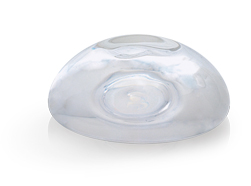
The two basic breast implant shape choices are round and teardrop (anatomical). Round implants are more commonly used than teardrop-shaped implants in the U.S. The main advantage of a teardrop-shaped implant is that a more natural shape may be achieved although this is controversial. Additionally, because these breast implants are more cohesive (more solid than liquid) there may be a lower risk of capsular contracture. However, the trade-off is less upper pole fullness, longer scar, firmer result, and more expense. Recent studies have shown less difference in outcomes between round and shaped implants than expected and higher risks of rotation than previously considered. For these reasons, Dr. Yates currently prefers teardrop implants only in patients whose goals cannot be achieved with round implants.
A textured implant can help in certain situations where a smooth implant is more likely to shift in position, such as poor elasticity or chest wall deformity. These may be more likely to stay put over time with a lower risk of displacement or bottoming out. However, textured implants can have a higher chance of rippling and palpability in patients without much coverage.
A recently discovered illness associated with breast implants is ALCL, a rare type of lymphoma. This is found most commonly (or possibly exclusively) with textured implants. Although ALCL is very rare and typically treatable, Dr. Yates is very conservative with safety-related issues and now uses fewer textured implants than he once did. We still use them but only for specific indications.
Silicone is a material that can be made more liquid or solid depending on the degree of cross-linking of the molecules, the thicker the material, the more cohesive the implant. Implants with greater cohesiveness may have improved safety and keep the silicone in place even in the face of rupture. Cohesive implants are a little firmer and can give a rounder breast shape. Each implant brand has a different cohesiveness of its standard round implants and its teardrop-shaped implants. The term gummy bear should be reserved for a cohesive silicone implant, although this is not always the case from office to office.
The advantage of cohesive, gummy bear implants is less rippling and more upper fullness if desired.
Many patients state they desire a specific breast implant profile, for example, high profile implants. The profile is the projection of the implant in relation to the diameter of the implant. A high profile implant has a smaller diameter and greater projection (away from the chest) at a certain volume whereas a moderate profile has larger diameter and less projection at the same volume. In reality, the best way to choose the profile is to match the correct diameter to the dimensions of the patient and choose which profile is best based on the volume of the implant. For example, a thin patient who desires large implants is going to need a high profile breast implant. Moderate and moderate plus profile implants provide a more natural result than high profile.
The Ultrahigh profile implant should generally be reserved for patients who want a very large implant for their frame. These have a higher risk of displacement over time and can look narrow, over projecting and “spaced” if chosen for the wrong patient.
There are four FDA approved implant manufacturers in the U.S., Mentor, Allergan , Sientra and Ideal. There are subtle advantages and disadvantages of all three brands. Some plastic surgeons are loyal to one implant brand for ease of use and familiarity. A comparison of some of the pros and cons of the different implant manufacturers can be found here
Dr. Yates is very experienced in breast augmentation providing service to the Salt Lake City metro area in Utah.